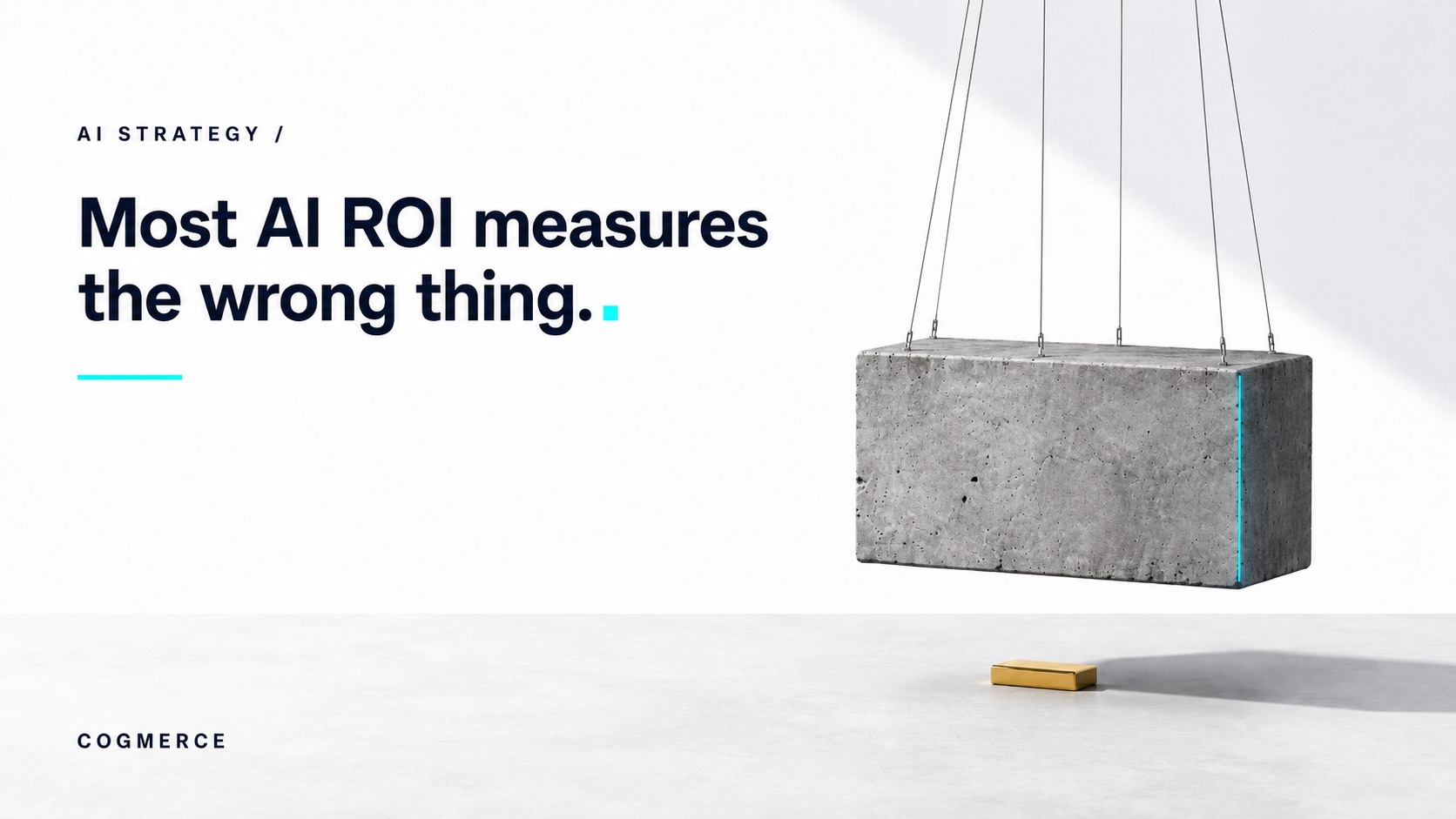
Most AI ROI calculations are wrong, and they are wrong in a predictable way. They measure the cost that is easy to count and ignore the value that is hard to. A team automates a task, multiplies the hours saved by an hourly rate, and presents a number. Sometimes that number is real. Often it describes savings that never actually materialise because the freed-up time gets absorbed rather than redeployed.
Why the simple calculation misleads
Hours saved is only value if those hours go somewhere productive. We worked with a defence contractor whose staff spent three to four hours summarising each large RFP, and an AI pipeline took that to minutes. The headline saving was over 18,000 dollars per employee per year. But that figure only became real because the freed time went into responding to more opportunities, not into longer coffee breaks. The case study is here. The technology created the capacity. The organisation had to choose to use it. ROI lives in that second step, and the simple calculation skips it.
The metrics that actually predict success
Across initiatives that paid off and ones that did not, a few signals separate them.
Redeployment, not just reduction. Did the time or cost the AI freed up get redirected to something that generates value, or did it quietly evaporate. This is the single biggest predictor and the one most business cases ignore.
Decision quality, not just speed. For systems that inform decisions, faster is only better if the decisions are at least as good. A lead-scoring system that surfaces better opportunities matters more than one that merely sorts faster.
Adoption rate. A tool nobody uses has an ROI of negative its build cost. Actual usage by the intended team, sustained past the novelty period, is a leading indicator that the value is real.
Error and rework rate. AI that produces output people have to fix has hidden costs that erase the headline savings. Measure the correction burden, not just the throughput.
When not to calculate ROI at all
Some AI initiatives should not be put through an ROI calculation, and forcing one does harm. Early-stage capability building, where you are learning whether and how AI fits your operations, is an investment in knowledge, not a line-item return. Demanding a clean ROI from an exploratory pilot either kills useful learning or produces a fabricated number that everyone pretends to believe. The honest move is to fund it as learning, set a decision point, and ask "what did we learn and what do we do next," not "what was the return this quarter."
The discipline
Measuring AI ROI well is less about better spreadsheets and more about honesty regarding what actually changed. Did value get created, did someone capture it, and would you make the same decision again knowing what you know now. Those questions catch the things a cost-per-hour calculation never will.
If you are weighing an AI investment, acquisition, vendor selection, or training programme, our team is happy to start with a conversation about scope and approach.
The views and findings in this article are shared for general information only. They are high-level perspectives, not legal, financial, regulatory, or other professional advice, and should not be relied upon for any specific decision or circumstance. For guidance tailored to your situation, please consult a qualified adviser.