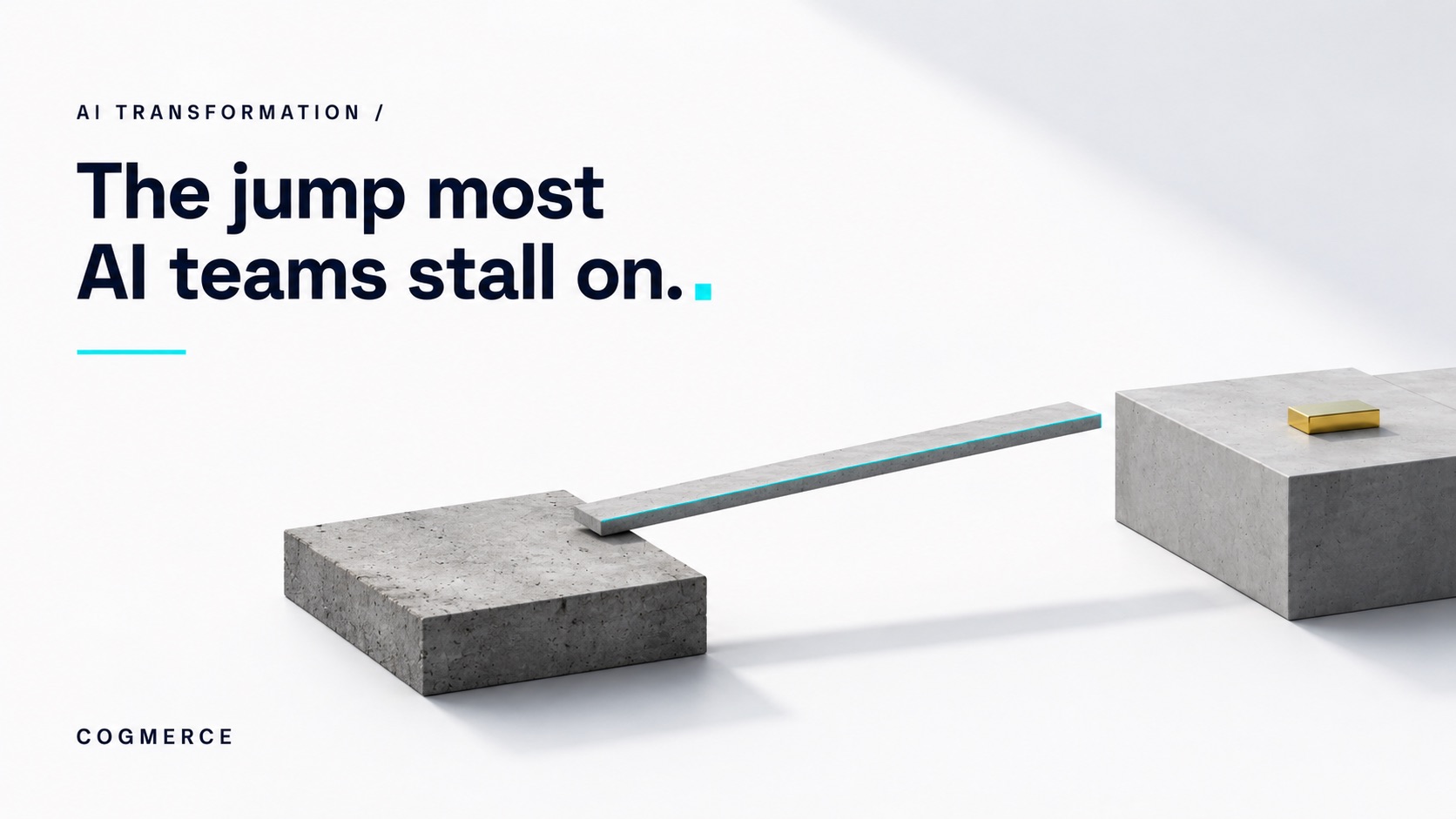
Most organisations with AI in production are running it by hand. Data scientists train models in notebooks, someone deploys them through a manual process, and the whole thing holds together because a few capable people keep it together. On our maturity scale that is Level 1 or Level 2, and roughly two-thirds of the companies we assess are there. The move to Level 3, automated pipelines, is the most valuable transition in MLOps and the one most companies stall on.
Why Level 1 organisations get stuck
The reason is rarely talent. It is that the manual process works just well enough to never become the priority. Models reach production, results come in, and the fragility stays invisible until the person who understands the pipeline goes on leave, or a model quietly degrades and no one notices for a month. Getting stuck at Level 1 is comfortable right up until it is not.
The five things to fix to reach Level 3
Moving to automated pipelines is concrete work, and it is the same handful of things almost every time.
Version control for data and models, not just code. You cannot reproduce a result you cannot reconstruct. If you do not know exactly which data trained a given model, you are not at Level 3 no matter what tools you own.
A repeatable training pipeline. Training should be a process anyone on the team can run and get the same result, not a notebook only its author understands.
Automated deployment. A model should reach production through a defined, automated path, so that shipping a new version is routine rather than an event.
Basic testing for models. Not just "does the code run" but "does the model meet a performance bar before it goes live." A model that regresses should fail the pipeline the way a broken build fails CI.
A rollback path. When a deployed model misbehaves, you need to get back to the last good version quickly. If your only option is to retrain and redeploy by hand under pressure, you are still at Level 1 where it counts.
The mistake that wastes the budget
The most common failure we see is buying a platform first. A team decides to "do MLOps," procures an expensive end-to-end platform, and then discovers the platform automates a workflow they have not actually defined. The tool sits half-used while the manual process continues underneath it. The order matters: fix the workflow, prove it works, then buy tools to automate the workflow you already understand. A platform accelerates a good process. It does not create one.
Where to aim
Level 3 is the right target for most organisations. It gives you reliability and reproducibility without the cost of continuous monitoring and automated retraining, which belong at Levels 4 and 5 and which most companies do not yet need. The goal is not to climb every rung. It is to climb the one in front of you, which for most teams reading this is the move out of the notebook and into a pipeline.
If you are weighing an AI investment, acquisition, vendor selection, or training programme, our team is happy to start with a conversation about scope and approach.
The views and findings in this article are shared for general information only. They are high-level perspectives, not legal, financial, regulatory, or other professional advice, and should not be relied upon for any specific decision or circumstance. For guidance tailored to your situation, please consult a qualified adviser.